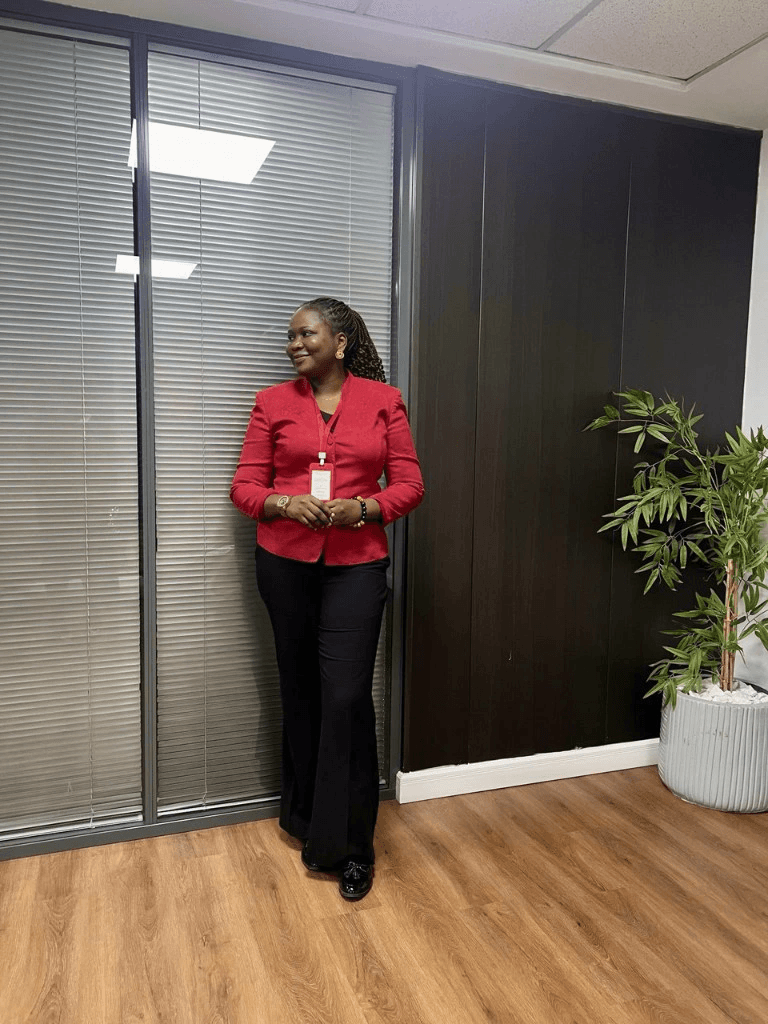
Seyi Jesuloluwa on the advantage of being the newest person in the room
Product manager Seyi Jesuloluwa has reset herself again and again across gaming, fintech, and AI. She makes the case that being the newest person in the room is not just something to survive, but a vantage point worth using: you notice what everyone else stopped seeing, if you spend that short window well.

Seyi Jesuloluwa on resetting, and learning to see what everyone else stopped noticing
A lot of career advice treats being new as a problem to solve quickly. Get up to speed, prove yourself, stop being the person who doesn't know things yet. Seyi Jesuloluwa has come to see it almost the opposite way. After stepping into product after product, across gaming, fintech, AI, and consumer tech, she has learned that being new is not just something to survive. It is sometimes the most useful thing you can be.
Seyi is a product manager who has built across startups, growth-stage companies, and consulting, taking products from ambiguous ideas to things people can actually use. She also co-founded Seddie, where she helps businesses turn ideas into digital products and practical AI solutions. If anyone has earned the right to talk about first days, it is someone who has had a couple of them.
We spoke to her as part of Day One, our series about the first days nobody really prepares you for. Hers is a story about the reset that comes with every new role, and what she has learned to do with it.
The reset that never fully disappears
Every new role, Seyi says, resets you a little. You go from knowing the room to being the newest person in it again, and that shift never completely goes away, though she is quick to add that it has gotten easier. What changed was not the discomfort itself but her relationship to it. "I've learned that being new doesn't mean being incapable," she says. "It simply means there are things you don't know yet."
Earlier in her career, the reset came with pressure. She wanted people to know she belonged, to prove herself quickly, to close the gap between arriving and being trusted as fast as possible. These days she carries it differently. She is comfortable saying, "I don't know this yet, but I'll find out," and she describes that small shift as one of the biggest changes in how she works.
What the newest person can see
Here is the part of Seyi's thinking that sets her apart. She believes that being new is not a disadvantage to overcome, but a vantage point worth using while it lasts. "Being new also gives you a perspective that people who have been in the environment for a long time might not have anymore," she says. "You notice things because you haven't become accustomed to them."
That noticing has a short shelf life, which is exactly why it matters. When she joins a new product, she resists the urge to rush to solutions just to demonstrate value. "Sometimes the most valuable thing I can do in the first few weeks is ask questions that the existing team has become too familiar with to ask anymore." A team that has lived with a product for years stops seeing its own assumptions. The newcomer still can, for a little while, and Seyi has learned to spend that window well rather than waste it trying to look like she already belongs.
She pairs that with a real humility about change. She does not walk into a new role and starts rearranging everything. "I spend time understanding why things are the way they are before deciding what needs to change," she says. Something can look inefficient from the outside, and then you learn the history and discover there was a good reason for it all along. Other times, it genuinely does need to change, and being new is what let you see it. The skill is holding both possibilities at once, which she sums up simply as balancing humility with curiosity. "I don't assume I know better simply because I've done something somewhere else, but I also don't assume I have nothing valuable to contribute because I'm new."
Understanding a user before building for them
If being new is a vantage point, the thing Seyi trains it on first is the user. Moving into a new product usually means learning a whole new person before you can build anything worth having, and she has a method for it that starts with herself. "I try to put myself in the user's shoes. I use the product repeatedly. I pay attention to what feels intuitive, what feels confusing, what I would expect to happen and where I get frustrated." Then she works to validate what she is seeing, getting real users to test where she can, studying the existing data, talking to the people who already understand the users, and paying closer attention to what people actually do than to what anyone assumes they will do.
That instinct is, she thinks, a big part of why she has been able to move across so many different products and still contribute quickly. "I don't need to know everything about the industry on day one. I need to understand the person I'm building for. Once I understand the user, the product starts making a lot more sense." It is a quietly radical reframe. The fastest way to be useful in an unfamiliar industry is not to fake fluency in the industry. It is to get close to the human being at the centre of it.

The room she almost let intimidate her
The first week she remembers most vividly was at Carry1st. Gaming itself was not new to her, since her first product experience had also been in games, but Carry1st felt much broader: a far larger user base, a global team spanning different countries, cultures, and accents, and a more structured onboarding than she had known before. "It felt like I had walked into a much bigger problem and was surrounded by very intelligent people trying to solve it." Some of them had been in gaming far longer than she had, and it was easy to look around and think, what am I doing here?
She had to fight the feeling of being small. What got her through was a reframe she still uses. "Experience in one area doesn't mean someone else has nothing to learn from me. I had my own perspective, my own product experience and my own strengths. I didn't need to know everything they knew. I needed to understand what I could contribute." And then she did the thing that settles the argument better than any pep talk. She proved it through the work. "I moved metrics. I pushed revenue 3x in the area I was working on, and I have the receipts." That first week stayed with her, she says, because it taught her something she now carries into every new room: you can feel intimidated by a place and still make a real impact in it.
What she has learnt about products
Moving through so many products has also shaped how Seyi thinks about the work itself, especially in her core territory of gamification and retention. Early on, she understood retention mechanically: if people come back, something is working, and if they don't, something needs to change. "People don't come back simply because you've added a reward, a notification or a new feature. They come back when the product consistently gives them a reason to return." Gamification can create that reason, she says, but it cannot rescue a product that does not actually provide value.
Over time she moved from "How do we get people to come back?" to "What would make this product worth coming back to?" and that small change reorganised how she thinks about engagement and growth. She has become far more interested in the behaviour behind a metric than in the metric on its own, which is the kind of lesson you tend to learn only by watching many different products succeed and fail up close.
Her side of that story includes Seddie, the company she co-founded while working full time, and it gave her a new respect for what building from zero really costs. "As a PM inside an organisation, you're usually operating within an existing system. As a founder, you're partly responsible for creating the system itself." It made her more pragmatic, she says, less willing to fall in love with an idea just because it was hers, and more insistent on the harder questions: whether people actually need the thing, whether they will pay for it, whether you can realistically deliver it with what you have. Courage and persistence, she learned, are not optional extras when you are trying to birth something that does not exist yet.
What she'd tell herself on day one
We ended where we always do, by asking Seyi what she would tell the version of herself standing at the start of her product career, before she knew any of this.
"I'd tell her to relax," she says. You don't have to know everything to be a good product manager. You need to be willing to learn, to ask good questions, to understand people, and to take responsibility for figuring things out. And she would tell that younger version something she has clearly made peace with the hard way: "Feeling like an imposter doesn't necessarily mean you don't belong. Sometimes it simply means you're standing at the edge of something you haven't done before."
Then she offers the line that could sit at the centre of this whole series. "I'd tell her not to compare her beginning to someone else's middle." So much of the pressure of a first day comes from measuring your raw start against everyone else's polished present. Seyi's answer is to stop, to trust the skills you already have, to pay more attention to the work than to whether anyone thinks you are good at the work, and to let the rest arrive in its own time.
You don’t need to walk into a room as the most experienced person in it. You need to be willing to learn, to contribute, and to notice what everyone else has stopped noticing, while you still can. Keep learning. Keep asking questions. Keep building. The confidence will catch up.
Day One is a Daysim series about the first days nobody prepares you for. Daysim is a secure platform where you can practise new roles before you begin.